Piero della Francesca was one of the most influential artists not only of the Renaissance, but also of the modern era. According to Roberto Longhi, his post-Impressionist rediscovery was due to Cézanne and Seurat, and he subsequently became a model for movements such as Metaphysical Painting, Magic Realism and the Roman School, as well as for artists including Carrà, Casorati, Morandi, Balthus and Hopper…
I would now like to share a summary of a book I recently read and found deeply engaging, one that reminds us how art bears important witness to our cultural identity: L’Enigma di Piero. L’ultimo bizantino e la crociata fantasma nella rivelazione di un grande quadro (The Enigma of Piero: The Last Byzantine and the Phantom Crusade Revealed Through a Great Painting).
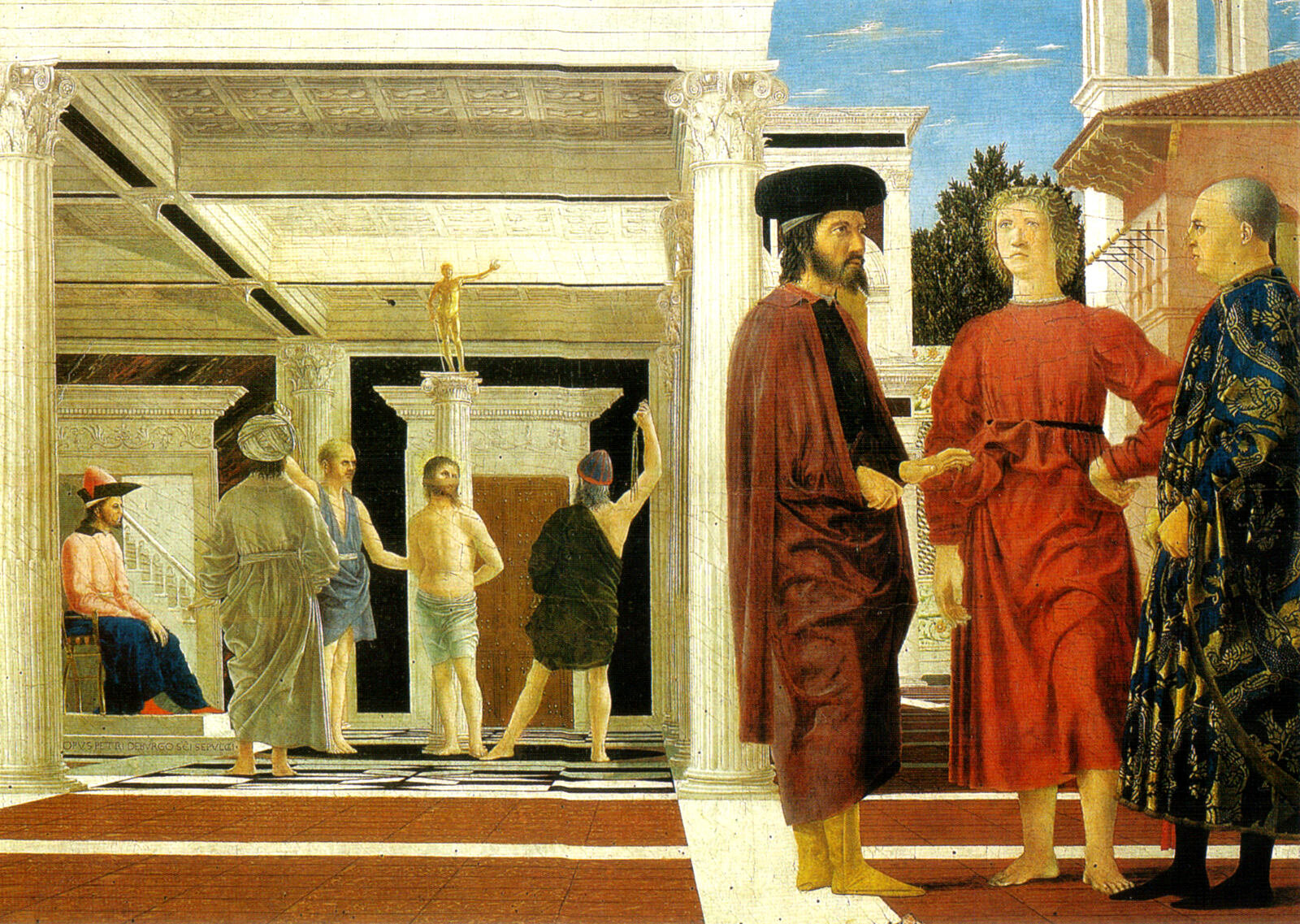
Through her study of The Flagellation of Christ, painted by Piero della Francesca around 1460, Silvia Ronchey takes us on a kaleidoscopic journey through a fundamental chapter of our history. Part detective story, part historiographical account and part iconographic study, the book rediscovers figures and events that help explain why the West gradually distanced itself from Byzantium, its interests and its memory — leaving its dynastic and religious legacy to Moscow, the “Third Rome” — even though the Byzantines themselves provided a decisive impetus to the development of the Italian Renaissance.
Through the identification of historical figures and the reconstruction of symbolic meanings, we discover that The Flagellation may have embodied a great dream: the political and religious project of a pro-Byzantine alliance. A call to arms to reclaim Byzantium, which had fallen to the Turks in 1453; to reunite the Latin and Greek Churches (divided since 1054); and to re-establish a unified Roman Empire (divided since 395), also with the support of the great Italian ruling dynasties, already linked by marriage to the Porphyrogeniti, the imperial heirs of the East.
The scourged Christ thus appears to symbolise Byzantium, while the diplomatic scene seems to be set in Ferrara. Among the elements identified are a portrait of Niccolò d’Este — perhaps the patron who commissioned the painting? — and the bell tower designed by Leon Battista Alberti. A personal note: I had the honour of contributing to the restoration of that bell tower in the 1990s, during my earlier career as an art restorer.
It was precisely in Ferrara, in 1438, that a large delegation from the East arrived for the first time, led by the Byzantine emperor, Basileus John VIII Palaiologos, to negotiate the reunification of the Churches and seek Western assistance against the advancing Turks. Although the painting dates from around 1460, the scene depicted is believed to refer to 1438.
The union of the Churches was achieved, but only briefly and largely on paper. The project to reunite the two Romes failed because of the West's inability to organise the necessary assistance.
The final blow to that great ambition came in 1472, with the marriage of Zoe Palaiologina, the last female descendant of the Byzantine imperial dynasty — Catholic at the time of her marriage, before returning to the Orthodox faith — to Ivan III Vasilyevich, Grand Prince of Moscow.
Ivan III thus became associated with the idea of the Russian ruler as the successor to the Byzantine Empire and defender of the Orthodox Church, now definitively separated from the Latin Church. This imperial legacy would later be expressed through the title of Tsar (from Caesar), officially adopted by Ivan IV.
When The Flagellation was painted, the hope of one final crusade was still alive. And perhaps that portable painting was intended precisely to accompany diplomatic delegations seeking military support.
If this story is ultimately the chronicle of a great disappointment, it also marks the beginning of another powerful impulse in the formation of Italian cultural identity.
Indeed, the Byzantine delegation accompanying the Basileus also brought to the Italian peninsula the philosopher Gemistos Plethon and his pupil Bessarion, an extraordinary figure — also identified in Piero's painting — who later became a cardinal and was even considered for the papacy on two occasions.
Plethon and Bessarion played a major role in spreading classical thought throughout Italy, contributing to the flourishing of Neoplatonic academies.
Bessarion, in particular, was responsible for the extraordinarily valuable legacy of ancient Greek manuscripts saved from destruction during the Ottoman conquest — a priceless treasure that forms the foundation of Venice's Biblioteca Marciana.
But why Venice rather than Rome?
As Ronchey explains, the Venetian Republic was perhaps the closest existing example of the mixed constitutiontheorised by Plato and Aristotle, combining elements of monarchy, aristocracy and democracy.
If not to an ideal state, Bessarion was at least entrusting Byzantium's bibliographic DNA to a genuine state, one capable of ensuring that this heritage would be collectively accessible.
A Few Curious Notes to Conclude (Among a Thousand Others)
Plethon's remains still rest today in the Tempio Malatestiano in Rimini, having been brought there by Sigismondo Malatesta during a final, desperate crusade to Mystras, in the Peloponnese, already occupied by the Turks. Another great figure who profoundly influenced Italian culture, Bessarion, died in Ravenna — like Dante… “Ravenna est la ville des morts.”
A fresco in the Sala Baglivi at the Hospital of Santo Spirito in Rome, attributed to Cavalier d'Arpino, appears to be the only painting produced in Italy commemorating the supposedly “Catholic” marriage — whose religious expectations were ultimately disappointed — between the last female descendant of the Orthodox Byzantine imperial dynasty and the Grand Prince of Moscow.
How fascinating it is to think of a time when art served the ambitions of patrons who recognised it as a powerful instrument of strategic communication, as well as a means of promoting their culture and personal prestige.
“There is no object more precious, no treasure more useful or beautiful than a book. Books are filled with the voices of the wise. They live, speak and converse with us; they inform us, educate us, console us and show us that things from the most distant past are, in fact, still present, bringing them before our eyes. Without books, we would all be handsome brutes.”
— Bessarion to Cristoforo Moro (Doge of Venice from 1462 to 1471)
Lorenzo Marabini