Terms of Use
All images of this website are copyrighted. They must not be reproduced without prior permission by author.
Privacy Policy
Cookie Policy
Website Terms of Use
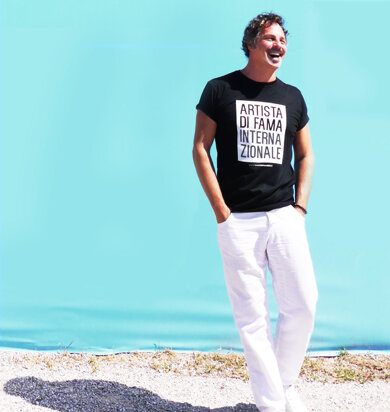
About
Lorenzo Marabini
“Things as they are do not seem satisfactory to me. […] This world, as it is, is unbearable.
I need the moon, or happiness, or immortality — something that may be absurd, perhaps, but that does not belong to this world. […] I will eliminate anyone who contradicts me, and contradictions themselves...”
— Albert Camus (Caligula)
Lorenzo Marabini — Artist Profile
Lorenzo Marabini (Cervia, 1973) currently lives and works in Imola, Italy. He studied at the Liceo Artistico di Ravenna and graduated with honours in Philosophy, specialising in Aesthetics, from the University of Bologna, with a thesis entitled “Plato and the Artistic Avant-Gardes of the Twentieth Century — Abstraction as a Prophecy of the New or a Reinterpretation of the Ancient?”
He lived in Milan for an extended period, where his engagement with dynamic environments connected to art, design, communication and design culture helped broaden a path already oriented towards crossing different languages and contexts.
His artistic practice develops primarily through painting, complemented at various stages by video, performance and interdisciplinary projects. Rather than adherence to a single artistic language, what characterises his work is an interest in the processes through which images, objects and individuals acquire meaning in the relationships they establish with one another, with their context, with memory and with the gaze of those who encounter them.
The human figure and identity, the relationship between part and whole, the duality of presence and absence, recognisability and transformation run through different bodies of work: Frames, born from an engagement with “real” and cinematic imagery; Individui (Individuals), centred on the human figure and identity; sHotlines, in which the ballistic gesture physically intervenes upon the painted surface; and the hybrids, diptychs and polyptychs of Tuttuno. Distinguere per unire (Animalia) (All in One. Distinguish to Unite), where distinct elements, sometimes apparently distant from one another, come together through juxtaposition to construct a new unity and generate new meanings.
Within this process, titles, irony and semantic shifts also play an important role. Words and images frequently interact, producing unexpected, sometimes paradoxical associations that resist a single interpretation, drawing on significant references to visual culture, as well as historical tradition, philosophy and science.
Although not directly derived from them, his research engages with questions explored across different fields of contemporary thought: the idea that individuals and objects cannot be fully understood as isolated entities, and that identity, function and meaning emerge instead from the network of relationships in which they exist.
This perspective finds resonances, at different levels, in the thought of Gilbert Simondon, for whom the individual must be understood through a process of individuation, in which its genesis is inseparable from the system of relationships within which it lives and operates, and from an original pre-individual dimension rich in potentialities.
It also resonates with the relational quantum mechanics of Carlo Rovelli, where the properties of things are defined through their interactions, acquiring a relative value in relation to what they interact with.
On the literary side, a parallel can be found in the perspective of Italo Calvino, particularly through one of his most celebrated characters, Palomar, whose attempts to observe and define things continually reveal the underlying web of relationships connecting them to the world and to the observer, far beyond their apparent individuality.
Within art criticism and art history, Arturo Schwarz holds particular significance among his various references, especially through his interpretation of Surrealism as an existential condition and a mental attitude of continuous intellectual exploration, rather than merely a formal style or a historically defined movement.
In this perspective, Surrealism becomes a movement of consciousness, a practice of freedom of perception and poetic rebellion against conventions, expressing the enduring human desire to question reality before taking shape as a particular technique or artistic language.
Within this prismatic vision of reality, what something is never entirely coincides with what it is in isolation: it is also what it becomes through its relationship with something else, within the duality of identity and otherness.
Exhibitions and Projects (Selected Highlights)
Marabini's exhibition history has developed since the 2000s through galleries, cultural venues, festivals, public events and interdisciplinary projects in Italy and abroad, including Ravenna, Bologna, Milan, Venice, Paris, Rovigo, Forlì, Faenza, Bagnacavallo, Imola and Rovereto.
In Ravenna, he participated in the group exhibition Astrazioni (Abstractions) and presented his solo exhibition Frames, accompanied by a critical text by Tobia Donà, at Ninapì Nesting Art Gallery, run by Chiara Fuschini and Giuseppe Padula. Throughout its activity, the gallery brought together contemporary art and international design, presenting works by artists including Hermann Nitsch, Italo Scanga, Dale Chihuly and Peter Shire (of the Memphis Group).
In 2011, he was among the artists selected for the 55th Premio Marina di Ravenna, organised by CAPIT/FaroArte in collaboration with the MAR – Museo d'Arte della Città di Ravenna, with a jury chaired by Claudio Spadoni. During the same period, he was selected by Carlo Polgrossi for 8 artisti alla Gervasia (Eight Artists at Gervasia), held at Villa Gervasia in Bagnacavallo.
In Milan, he presented Ritratti (Portraits) at MalagAtelier; in Dozza, he presented Individui (Individuals) at Le Bistrot, one of the venues associated with the Muro Dipinto (Painted Wall) art circuit, accompanied by a critical text by Annalisa Cattani.
In Paris, he participated in the group exhibition C-FATAL at Galerie Hubert Karaly, while in Venice he presented works from the Animalia series at Paradiso Perduto, a historic venue in Venice's contemporary cultural life. Works from the same series were also exhibited at the Biennale del Disegno di Rimini (Rimini Drawing Biennial).
In 2013, he participated in Rivers of A.I.R. – Art Industry Recycling, a project exploring the relationship between art, industry and sustainability, promoted by Cartiere del Polesine and Comieco and presented at Pescheria Nuova in Rovigo. The accompanying catalogue was curated by Tobia Donà and Beatrice Buscaroli.
Part of his artistic journey has also developed through encounters between art, business, design and contemporary culture.
In Milan, he participated in HOMI – Fiera degli Stili di Vita, at Fiera Milano Rho, with Arte da Mangiare Arte / Società Umanitaria. He also presented Animalia at Palazzo delle Stelline during the Bottiglie Aperte event, in collaboration with Presso Kook Sharing, a Milan-based project exploring the intersection of design, living culture and new models of shared spaces.
In 2019, he was selected by Angelo Crespi for Popack – Art Exhibition on Packaging, a three-year project presented at Milano Licensing Day, dedicated to developing collaborations between artists and contemporary brands.
His works and projects have also been presented in unconventional venues and events, including Abbinamenti (Pairings), held during Vinessum at the Antico Convento di San Francesco in Bagnacavallo, continuing an exhibition practice open to engagement with different audiences and contexts.
Video, Performance and Moving Image (Selected Highlights)
A significant aspect of Marabini's artistic journey, developed both before and alongside his painting practice, involves video, performance and experimentation with moving images.
Within the context of research into new audiovisual languages, he participated in Netmage – International Live Media Festival in Bologna, an event associated with Xing, contributing to EYEROPHANY, an installation and performance event at Palazzo Re Enzo dedicated to David Lynch, in a project involving Enrico Ghezzi, Angelo Badalamenti, Lorenzo Miglioli and Emiliano Montanari.
Together with Emiliano Montanari, he also created Slow Motion (Nic Endo Remix) for Tying Tiffany, presented at the Bizzarro Film Festival in Bologna and subsequently broadcast on MTV.
In 2021, he presented his solo exhibition Tuttuno. Distinguere per unire (All in One. Distinguish to Unite) at Pallavicini22 Art Gallery in Ravenna, curated by Annalisa Cattani.
Bringing together works created over several years, the exhibition made particularly explicit an artistic exploration founded on the relationships between distinct elements and on the possibility of generating unexpected associations and new perspectives of meaning through the interplay between images, and between images and words.
In 2023, he participated with his sHotlines project in the international exhibition HUMAN RIGHTS_HOPE, dedicated to human rights and peace, held at the Fondazione Campana dei Caduti in Rovereto, as part of initiatives promoted by AIAPI – International Association of Art and connected to the international UNESCO network.
That same year, he presented Non c'è più spazio per la fantasia, è tutto occupato dalla realtà… (There's No Room Left for Imagination, Reality Has Taken It All…) at VIÙ Studio in Imola, continuing his exploration of the relationship between painting and spaces dedicated to architectural design.
In 2026, he wins the art competition marking the 1,500th anniversary of the death of Theodoric the Great, organised in Ravenna by CARP APS and Pallavicini22 Art Gallery, in collaboration with the Archivio Collezione Ghigi-Pagnani. The finalist artworks are exhibited at the gallery from 12 to 19 September 2026.
What They Say About Him
“Drawing on the worlds of communication and advertising, Lorenzo Marabini’s work finds its strength in provocation and paradox, exploiting misunderstandings to elicit reactions so immediate that they are felt instinctively.”
— Tobia Donà (Academy of Fine Arts, Bologna)
“…the depth of this sophisticated and courageous artistic inquiry, moving forwards and backwards through the folds of art history.”
— Annalisa Cattani (Marketing and New Media, University of Ferrara)
“Marabini is […] a self-aware artist who confronts reality and seeks to represent it subjectively.”
— Ariberto Scolli (pseudonym of Maestro Roberto Prosseda, Mendelssohn Association)
“Marabini’s portraits radiate an enigmatic energy that leaves viewers astonished, yet at the same time deeply gratified. Indeed, the intense inner luminosity of their gazes stirs a revitalizing movement of the spirit, in a kind of poignant catharsis.”
— Guido Grandi, Attorney at Law (Bologna)