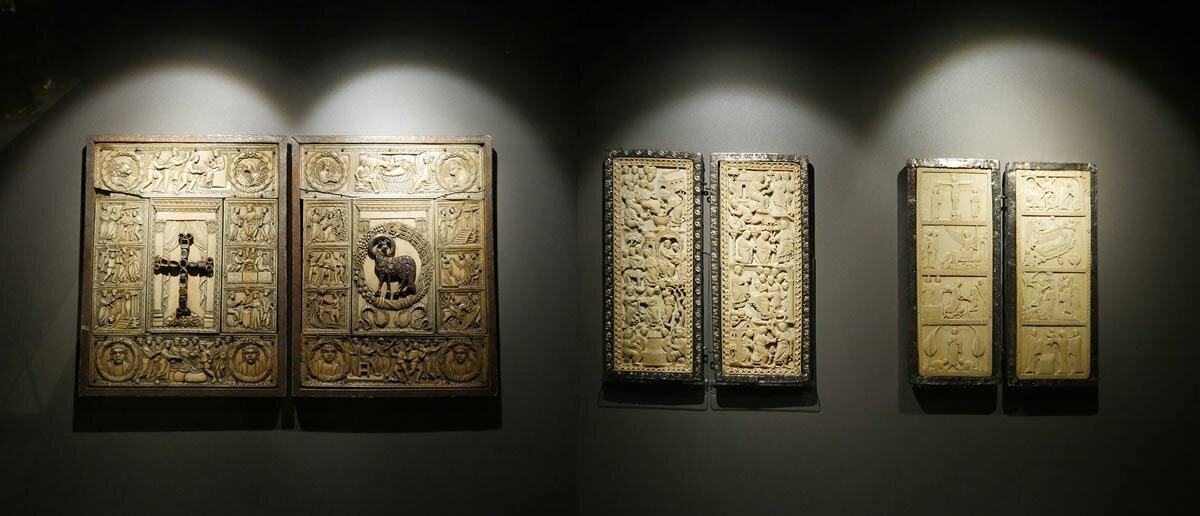
Pictured: Gospel Book Cover known as the “Five-Part Diptych” – last quarter of the 5th century (held at the Museo del Duomo, Milan), alongside other historical diptychs.*
The term “diptych” — from the Greek words δίς and πτύσσειν, later adopted into Latin as diptychum — derives from δίς (dís), an adverb meaning “twice”, and πτύσσειν (ptýssein), the present active infinitive of the verb πτύσσω (ptýssō), meaning “to fold”, “to wrap” or “to fold over”.
In ancient times, the term referred to any object folded in two, and later to an object consisting of two equal parts or panels. It was primarily associated with writing. Made of two wooden or ivory tablets joined by a hinge, allowing them to close like a book, diptychs featured written text on one side and engraved images on the other.
Originally, the images were mostly dedicated to distinguished figures and their achievements.
Diptychs played an important role in political and social life. In ancient Rome, they were exchanged among members of high society as prestigious commemorative objects, marking appointments, anniversaries, marriages, imperial decrees and other significant occasions.
Over time, religious functions superseded their classical and pagan purposes: “apostles or saints appear in place of consuls; Christ and Mary replace emperors and empresses; angels take the place of Victories; and the Magi pay homage just as the barbarians once did.” *
Images gradually acquired greater importance, often at the expense of the written text.
In some cases, the number of panels also increased. Beautiful examples from different periods survive, including five-part compositions — one central panel and four surrounding panels — such as those now preserved among the treasures of Milan Cathedral. **
The diptych is a compositional form that has been handed down through the centuries, gradually becoming part of art history. Painted diptychs began to appear, while medieval religious art developed elaborate polyptych altarpieces. Later, the secular commemorative function also re-emerged.
One of the most famous Renaissance examples is the painted diptych *** ** depicting the double portrait of the Dukes of Urbino, Battista Sforza and Federico da Montefeltro, by Piero della Francesca.
Federico da Montefeltro was one of the most important patrons of the Italian Renaissance. He also played a significant role in the dissemination of classical culture throughout the Italian peninsula. As historian Silvia Ronchey explains — a subject discussed in another article on this blog — he helped preserve books that Bessarion had rescued from Byzantium, before they were eventually transferred to Venice.
(Continued below the image)

* Pictured: Double Portrait of the Duke and Duchess of Urbino, Piero della Francesca, 1465–1472 (Uffizi Gallery, Florence).*
The diptych thus originated as a “cover” for texts (intended as gifts) announcing important news, and later came to accompany sacred texts.
Over time, images themselves gradually acquired a life of their own, depicting both sacred and secular subjects, with all the universal communicative power that distinguishes them.
Lorenzo Marabini
(*) Further Reading and Bibliographic References:
http://www.treccani.it/enciclopedia/dittico_%28Enciclopedia-dell%27-Arte-Antica%29/
(**) Diptychs from Different Periods Preserved in the Treasury of Milan Cathedral:**
https://www.milanotopnews.it/cultura/16490-il-tesoro-del-duomo-di-milano.html